

Millions of football fans across Southeast Asia place bets every matchday without fully understanding the mechanics behind the odds they’re reading. Kèo nhà cái — the structured odds system used across Vietnamese and regional betting markets — is more layered than it looks at first glance. Whether you’re watching a Champions League clash or a V.League fixture, knowing how to read and interpret these odds is what separates informed bettors from those who are just guessing. Kèo Nhà Cái has built its reputation as a trusted analysis platform specifically to help fans bridge that knowledge gap.
The Foundation: What Kèo Nhà Cái Actually Means
In Vietnamese football betting culture, “kèo nhà cái” literally refers to the odds lines set by bookmakers. These aren’t random numbers — they reflect a combination of team form, injury reports, historical head-to-head records, market demand, and real-time money flow. Understanding that odds are constructed rather than simply calculated changes how you approach every bet.
There are 3 primary bet categories that make up the core of kèo nhà cái:
Asian Handicap (Kèo Chấp)
The Asian Handicap was developed specifically to eliminate the draw outcome and create more balanced wagering on mismatched fixtures. The stronger team gives a goal advantage to the weaker side. Common lines include:
- 0.25 handicap (1/4 ball): The favorite gives a quarter-goal start. A win by any margin returns full payout; a draw splits the stake (half win, half push).
- 0.5 handicap (half ball): A draw counts as a loss for the favorite’s backers. Clean result — no push possible.
- 0.75 handicap (3/4 ball): A 1-goal win by the favorite returns half profit; a 2-goal win pays in full.
- 1.0 handicap (1 ball): The favorite must win by 2 or more goals for backers to profit. A 1-goal win is a push.
Over/Under (Kèo Tài Xỉu)
Rather than picking a winner, tài xỉu asks whether total goals in a match will go over or under a set line. A 2.5 line is common in evenly matched games — over means 3+ goals, under means 2 or fewer. Quarter and half lines follow the same push logic as Asian handicap.
1X2 (European Odds)
Straightforward win-draw-win betting. No handicap adjustment. Because draws are in play, odds for the favorite are typically longer than the equivalent Asian handicap price. Useful when you genuinely expect a draw.
Reading the Odds Board: A Practical Breakdown
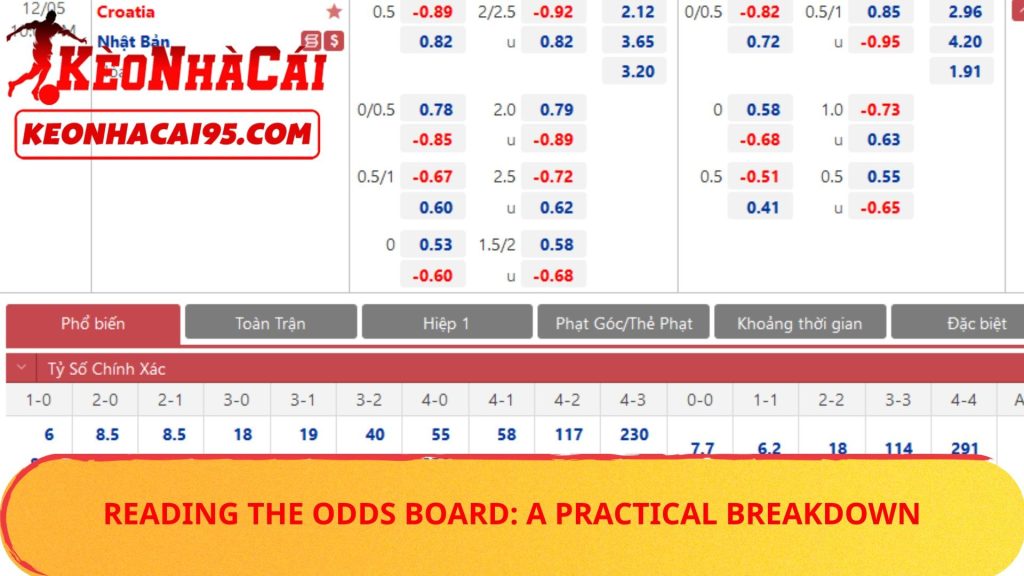
Opening an odds board can feel chaotic until you know what you’re looking for. Here’s how to approach it:
Step 1 — Identify which team is listed first. In kèo nhà cái, the home team typically appears at the top. If a neutral venue is used, bookmakers flag this.
Step 2 — Read the handicap direction. The team shown in red (or bold) is usually the favorite giving the handicap. The team shown in standard text is receiving it.
Step 3 — Check the odds value alongside the line. The number next to the handicap (e.g., 0.90 or 0.95) is the multiplier applied to your stake if your bet wins. Values below 1.00 indicate a vig-adjusted market.
Step 4 — Compare across multiple bookmakers. Odds for the same match can vary by 0.05 to 0.10 across different platforms. Shopping lines consistently adds up over a full season.
Step 5 — Watch for line movement. If a handicap shifts from 0.5 to 0.75 in the hours before kickoff, that’s a signal — sharp money or significant team news has hit the market.
Why Kèo Chấp Dominates Southeast Asian Betting Markets
Asian Handicap betting accounts for the majority of football wagering volume in Vietnam, Thailand, Indonesia, and Malaysia. Several structural reasons explain this dominance:
It removes the draw. Football produces a lot of draws — roughly 25% of top-flight matches end level. Eliminating that third outcome nearly doubles the implied probability of each remaining result, making every match feel more actionable.
It creates tighter lines on mismatches. A fixture between a top-4 side and a relegation candidate is difficult to price on 1X2 because the favorite’s odds collapse. Handicap betting restores balance and keeps both sides of the market liquid.
It rewards research. Unlike simple win-or-lose bets, handicap lines reward granular analysis — understanding whether a team wins by 1 or by 3 matters. Bettors who track team tendencies in specific situations (home form, after European fixtures, in must-win games) find real edges in handicap markets.
According to data compiled at https://keonhacai95.com/, Asian Handicap fixtures consistently generate the highest trading volumes and the most frequent line adjustments in the lead-up to kickoff — a strong indicator that informed bettors concentrate their activity here.
Common Mistakes When Placing Kèo Nhà Cái
Even experienced bettors fall into repeatable traps. The most common:
Ignoring Team News Until Kickoff
A key striker ruled out 45 minutes before a match can shift a handicap line by a full quarter goal. Monitoring official team announcements from the moment lineups become available (usually 60–75 minutes pre-match) is non-negotiable.
Over-Weighting Recent Form
A team on a 5-game winning streak looks dominant on paper. But if 4 of those wins came against bottom-half opposition and the upcoming opponent is a direct title rival, that form streak is noise. Context always outranks raw sequence.
Treating Tài Xỉu as a Coin Flip
Over/under markets are as information-dense as handicap lines. Weather conditions, referee assignment, match importance (cup final vs. dead rubber), and both teams’ defensive organization all have measurable impacts on goal totals. Treating it as a 50/50 bet ignores available signal.
Chasing After Losses
The most expensive habit in sports betting. A losing run triggers the impulse to increase stakes and recover quickly. Disciplined bettors treat each bet as independent and hold stake sizes fixed regardless of recent outcomes.
Building a Sustainable Approach to Betting Analysis
Kèo nhà cái is not a shortcut to income — it’s a framework for structured, informed wagering. Bettors who treat it as such tend to sustain their activity longer and make sharper decisions over time.
A few practical habits worth building:
- Keep a betting log. Record every bet placed, the odds taken, the reasoning behind it, and the result. Patterns in your own decision-making become visible within a few hundred records.
- Set a fixed weekly budget and treat it as an entertainment expense rather than an investment pool.
- Focus on 2 to 3 leagues you know deeply rather than spreading attention across every competition on the board.
- Never bet on a market you can’t explain. If you can’t articulate why the handicap line is set where it is, skip the match.
Conclusion
Kèo nhà cái covers a wide ecosystem of betting markets, but Asian Handicap remains the most analytically rich format for football bettors who want to apply real research. Understanding how lines are built, how to read odds movements, and where common decision errors cluster puts you in a fundamentally stronger position than those who pick on instinct alone. The mechanics aren’t complicated once the framework is clear — and applying that framework consistently is where the real edge lives.
