

Quick Answer
- Monero (XMR) offers the strongest default privacy among the three networks, making it the primary choice for users who value data confidentiality.
- Dash (DASH) aims to provide a user-friendly digital payments experience, emphasizing fast transaction times and network usability.
- PIVX balances privacy mechanics with a flexible, energy-efficient framework that allows users to earn network staking rewards.
Your choice depends heavily on whether your daily priority is structural data protection, swift point-of-sale spending, or securing passive ecosystem yields.
Key Takeaways
- Monero obscures transaction details automatically network-wide, masking the sender, recipient, and transfer amount by default.
- Dash treats data protection as an optional choice, shifting its primary design focus toward speed and payment convenience.
- PIVX runs on a Proof-of-Stake model, offering variable staking rewards for individuals who participate in securing the network.
- Centralized trading venues continue to apply stronger compliance filters, altering public exchange access and market liquidity for privacy assets depending on local jurisdictions.
The modern landscape of digital finance has shifted how public ledgers are analyzed. As network-tracking software becomes standard utility for blockchain analytical groups, user demand for financial privacy has evolved into a core consideration for everyday peer-to-peer transfers.
However, a digital currency must balance privacy with real-world function. Evaluating an asset for daily transactions requires analyzing practical overhead costs like network fees, confirmation speeds, ecosystem access, and overall wallet design. Here is how PIVX, Dash, and Monero compare as transactional tools in 2026.
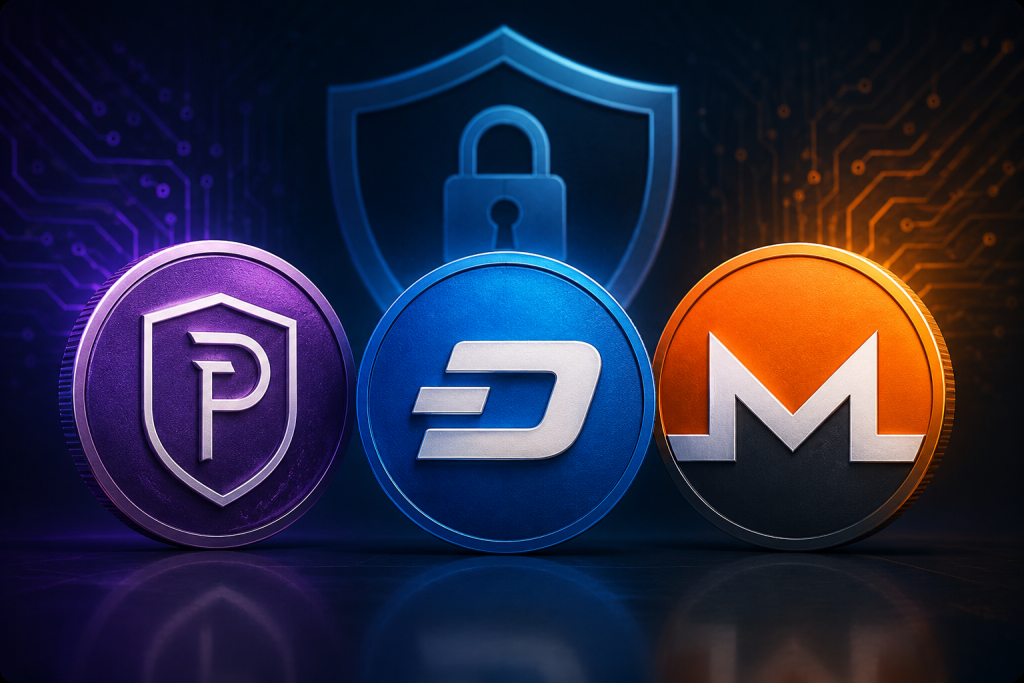
PIVX vs Dash vs Monero at a Glance
| Feature | PIVX | Dash | Monero |
| Privacy Tech | SHIELD (zk-SNARKs) | PrivateSend (CoinJoin mix) | Ring Signatures, Stealth Addresses, RingCT |
| Enforced? | Optional | Optional | Mandatory (Always on) |
| Consensus | Proof-of-Stake (PoS) | Proof-of-Work + Masternodes | Proof-of-Work (RandomX CPU) |
| Avg. Tx Speed | ~1 to 2 seconds (SwiftX) | Instant (<1 sec via InstantSend) | ~2 minutes (Block time) |
| Average Fees | Less than $0.01 | Less than $0.01 | $0.02 to $0.06 |
| Staking Yield | Yes (Variable) | Yes (Via 1,000 DASH Masternode) | No (Mining only) |
| Market Cap | ~$4.5M – $5 Million | ~$420 Million | ~$5.7 Billion |
| Primary Focus | Shielded Staking & Governance | Fast, Digital Consumer Payments | Structural Ledger Anonymity |
Current Price and Market Performance
As of June 2026, XMR trades around $324, DASH around $35, and PIVX around $0.04, though asset prices can change quickly based on broader market volatility. Monero (XMR) maintains the highest market capitalization among privacy-focused assets, while Dash (DASH) represents a mid-tier transactional asset. PIVX trades in the micro-cap range, with live pricing hovering around $0.04 as of June 2026. For traders tracking its daily movements, monitoring the PIVX USDT chart provides excellent insight into the recent accumulation patterns of this low-fee validation network.
Understanding PIVX, Dash, and Monero
PIVX: Privacy with Staking Rewards
Launched in 2016, PIVX utilizes an eco-friendly Proof-of-Stake (PoS) system where users deposit tokens to validate blocks. Its data layer uses a custom zk-SNARKs implementation called SHIELD to conceal wallet addresses and balances.
- Advantages: Energy-efficient; zero-knowledge privacy features; accessible staking.
- Drawbacks: Small ecosystem; lower market liquidity.
Dash: Designed for Fast Digital Payments
Dash features a two-tier network combining Proof-of-Work mining with high-powered Masternodes (requiring a 1,000 DASH collateral deposit). This setup powers InstantSend for sub-second block locks and PrivateSend for optional on-chain coin mixing.
- Advantages: Near-instant settlements; low friction; strong historical merchant focus.
- Drawbacks: Optional privacy settings; coin mixing can be slow.
Monero: The Privacy Leader
Monero enforces privacy network-wide by default. It natively masks ledger data using three integrated core components: Ring Signatures (hiding senders), Stealth Addresses (hiding recipients), and RingCT (hiding transaction amounts).
- Advantages: Mandatory confidentiality; full token fungibility; decentralized mining.
- Drawbacks: Two-minute average block times; declining access on centralized exchanges.
Which Privacy Coin Offers the Strongest Privacy?
Comparing Privacy Technologies
The foundational difference lies within the design architecture. Dash uses an implementation of CoinJoin, which chunks payments into uniform fragments and shuffles them among participating network users. While useful for breaking direct visible paths, modern chain-analysis tools can piece these patterns back together if the overall pool of mixing participants is low.
PIVX’s zk-SNARKs protocol takes a different mathematical path, enabling users to prove a transaction is valid without revealing any underlying data fields, effectively breaking historical on-chain links.
Monero’s structural defense is its network uniformity. Because it does not operate an isolated public pool to trade against, human error cannot accidentally expose a user’s transfer.
Can Privacy Coins Be Tracked?
While modern forensic blockchain firms can occasionally trace details on optional privacy networks if users fail to implement advanced configurations, Monero’s enforced protocol design continues to provide strong resistance against commercial chain analytics tools.
Privacy Comparison Verdict
Winner: Monero. By implementing mandatory encryption across every address and balance, it minimizes user configurations and offers the most robust default data defense.
Which Privacy Coin Is Fastest and Cheapest to Use?
For standard real-world applications like retail checkouts or point-of-sale use, verification speed is a major practical factor.
Dash and PIVX utilize their respective validation pools to securely lock transactions within seconds, matching the flow of traditional payment networks. On the cost side, both assets are highly economical, operating with average fees below one cent. Monero transfers require more computational data storage because they carry extensive cryptographic proofs, raising its average network transaction fee to between $0.02 and $0.06.
Speed and Cost Verdict
Winner: Dash. Its InstantSend technology ensures fast network settlement with low fees, favoring high-frequency transactional environments.
Investing and Passive Income
Earning validation rewards while holding an asset depends entirely on how the underlying blockchain achieves consensus.
- PIVX: PIVX staking rewards are variable and depend on network conditions, total active participation, and individual wallet setup. It provides an accessible framework where users can stake assets directly from a local wallet without minimum balance requirements. This ease of entry makes it highly competitive alongside other modern blockchain projects; much like how looking up the Phychain token price highlights how supply-chain networks are gaining traction, PIVX continues to demonstrate the strong market appeal of functional tokenomics.
- Dash: Requires substantial capital to earn native infrastructure yields. Setting up a dedicated Masternode demands an unyielding, flat collateral deposit of 1,000 DASH, which can be cost-prohibitive for casual network participants.
- Monero: Does not feature a passive staking structure. As a Proof-of-Work blockchain, its RandomX algorithm is uniquely tailored for consumer-grade CPUs, allowing everyday hardware owners to mine tokens instead of relying on specialized ASIC farming units.
Passive Income Verdict
Winner: PIVX. It features the lowest barrier to entry for everyday users looking to build a variable network yield on privacy-focused holdings.
Adoption, Utility, and Regulatory Compliance
Privacy coins remain legal in many jurisdictions, but exchange access has become more limited because centralized platforms face stronger compliance pressure. Major global trading desks (such as Binance) have adjusted their asset listings in regions like the European Union to remain compliant with evolving anti-money laundering (AML) frameworks.
Because Dash allows users to utilize completely transparent transactions by default, it has faced less listing pressure than Monero, retaining wider integration with standard wallet providers, hardware devices, and brokerage apps.
Final Verdict: Which Privacy Coin Should You Choose?
- Choose Monero if your core objective is rigorous data confidentiality, and you prioritize ledger-wide encryption over immediate point-of-sale confirmation speeds.
- Choose Dash if you are seeking a highly liquid, payment-focused digital asset designed for quick transactions with minimal overhead fees.
- Choose PIVX if you prefer a balance of zero-knowledge privacy features alongside an accessible, low-barrier Proof-of-Stake ecosystem.
Best Asset by Category
- Best for Privacy Infrastructure: Monero
- Best for Payment Speed: Dash
- Best for Staking Integration: PIVX
Frequently Asked Questions
Is Monero still the leading privacy coin?
Yes, from a structural design standpoint. Monero is widely recognized as the market leader for data security due to its network-wide, non-optional privacy protocols.
Is Dash private enough for basic transactions?
For shielding casual P2P transfers from public tracking, Dash’s PrivateSend provides functional privacy. However, it is not engineered to withstand high-level, corporate-grade forensic chain audits.
Can you stake Monero like PIVX?
No. Monero utilizes a Proof-of-Work architecture. New tokens can only be generated by allocating physical computer processor (CPU) mining power to validate blocks.
Which privacy coin has the lowest network fees?
Both Dash and PIVX deliver average network fees below a penny, making them structurally cheaper per transfer than Monero’s larger, encrypted data payloads.
Are privacy coins legal to hold and use?
Ownership rules depend entirely on your local region. While holding these assets is perfectly legal under most international property frameworks, finding them on centralized fiat on-ramps has become harder due to tightening compliance standards on digital token exchanges.
