

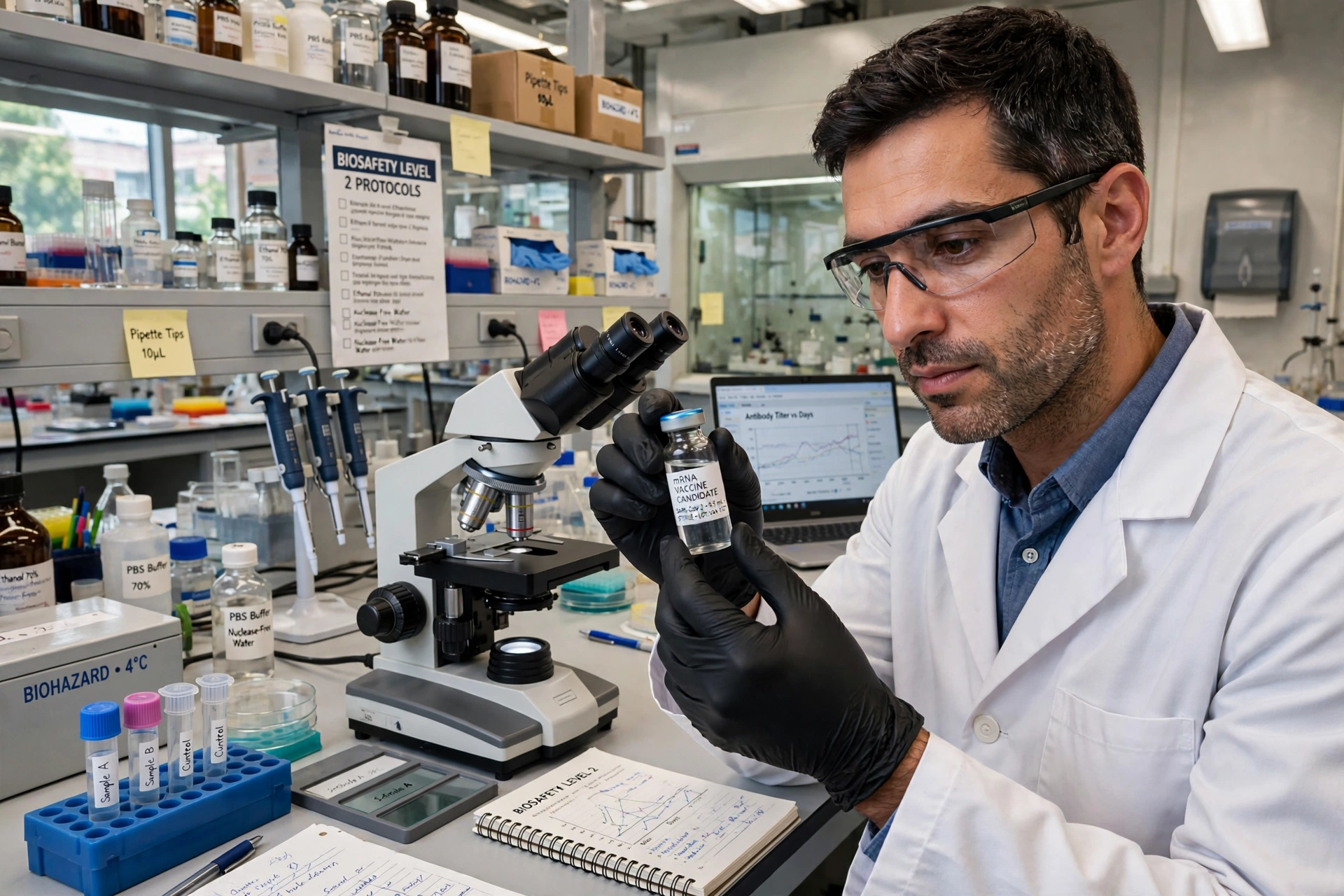
A personalised cancer vaccine given alongside an established immunotherapy drug has been found feasible to make and administer, with an acceptable safety profile, in a small phase 1 trial in ovarian cancer. The study, published in Nature Medicine, tested the NeoVax vaccine combined with nivolumab in patients whose disease was platinum-sensitive. The authors are careful about what the work shows: this was an early-stage trial designed first to test safety and practicality, not to prove that the treatment extends life.
That caution is the right starting point for everyday readers looking for a plain-English briefing. Ovarian cancer is often diagnosed late, and although many patients respond at first to platinum-based chemotherapy, the disease frequently returns. A treatment that could train the immune system to recognise a person’s own cancer is an attractive idea, but attractive ideas in oncology must survive years of testing. This trial is best read as a first checkpoint passed, not a finish line crossed.
Teaching the immune system a new target
NeoVax belongs to a class called personalised neoantigen vaccines. Researchers sequence DNA from a patient’s tumour and from healthy tissue, and look for mutations that produce altered proteins, known as neoantigens, which appear on cancer cells but not on normal cells. Algorithms then predict which of those fragments are most likely to be recognised by the immune system. A bespoke vaccine is then made for that one patient to present those targets to immune cells.
The personalisation is both the promise and the challenge. A vaccine matched to an individual’s tumour could, in theory, focus the immune response where it is needed and spare healthy tissue. In practice, every step takes time and specialist infrastructure: biopsy, sequencing, prediction, manufacture, quality checks and delivery, Demonstrating that this chain can be completed reliably for trial patients is itself a meaningful result, which is why researchers use the word feasible with care and pride.
Why researchers paired two treatments
In the trial, patients with platinum-sensitive ovarian cancer received the personalised vaccine together with nivolumab, a checkpoint inhibitor that blocks the PD-1 pathway and helps release a brake on immune cells. The logic of the combination is straightforward to state and hard to execute: the vaccine tries to teach the immune system what to attack, while nivolumab tries to stop the cancer from switching that attack off. Phase 1 studies ask whether such a plan can be delivered safely enough to justify larger trials.
On that primary question, the investigators report an acceptable safety profile, with patients monitored closely for immune-related side effects of the kind known to occur with checkpoint inhibitors and vaccines. No early-phase result can rule out rarer harms, because the numbers are small. Nor can a study of this size and design separate the effect of the vaccine from the effect of nivolumab, or from the natural course of disease in a selected group of patients. Those limits are not flaws to hide; they are the reason phase 2 trials exist.
Context helps here as well. our recent reporting has followed how quickly medical technology can move from promise to practice, and vaccines of this kind sit at the demanding end of that spectrum. Each dose is a small manufacturing project, not a vial taken from a shelf, so cost, speed and consistency will matter as much as biology if the approach is ever to reach routine care.
Ovarian cancer and the need for new options
Ovarian cancer has proved resistant to immunotherapy strategies that transformed care for some other cancers. Many ovarian tumours carry relatively few mutations that the immune system can easily see, and the environment around the tumour can suppress immune activity. A neoantigen vaccine is an attempt to work around the first of those problems by deliberately highlighting the mutations that do exist. Whether highlighting them is enough, in enough patients, remains an open question that only controlled trials with survival and response endpoints can answer.
Patients and families reading headlines should therefore hold two thoughts at once. The first is genuine: a highly individualised treatment was built for people with a hard-to-treat cancer, given safely in a formal trial, and reported in a leading journal. The second is protective: nobody should expect this vaccine to be available as standard treatment, or assume it would help in their own case, on the basis of phase 1 data. Anyone considering a trial should discuss eligibility, timing and alternatives with their oncology team.
How to talk to your doctor about trials
What happens next will be watched closely. Larger, ideally randomised studies would need to show that adding a personalised vaccine improves outcomes that matter, such as how long the cancer stays controlled, compared with existing care. Researchers will also need to shorten manufacturing time, reduce cost and show that immune responses measured in blood tests actually translate into attacks on tumours. Regulators will ask whether the benefit justifies the complexity.
For now, the fairest summary is measured. The NeoVax and nivolumab combination can be made and given to patients with platinum-sensitive ovarian cancer with a safety profile the trial team judged acceptable. That is a necessary step, and a hopeful one, on a long road. Science advances this way more often than by sudden breakthroughs: a careful study, honestly reported, that earns the right to ask a bigger question next.
