

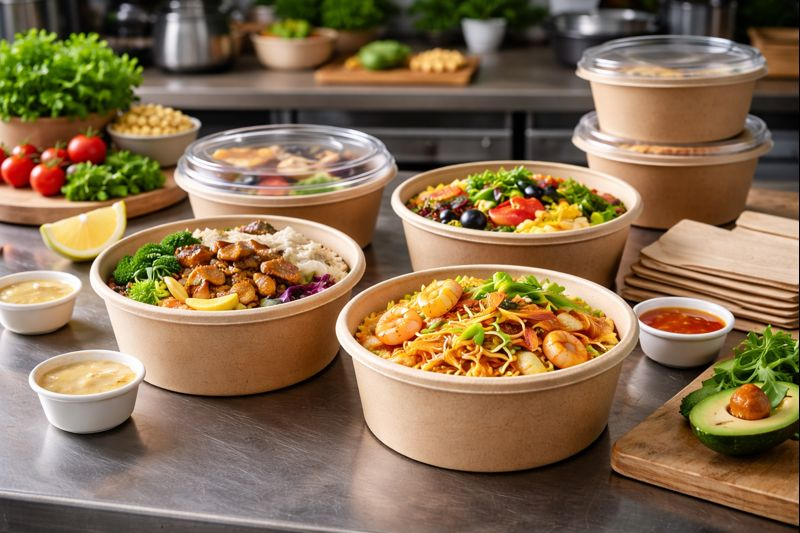
Introduction: Why Salad Bowls Are No Longer a Minor Detail
Salads have evolved. What was once a side dish has become a core menu category—grain bowls, protein-packed salads, poke-style mixes, and warm vegetable bowls now anchor menus in cafés, casual dining restaurants, and delivery-focused kitchens.
As salads become more complex and customizable, the bowl they are served in matters more than ever. Size, depth, rigidity, and material all influence portion control, presentation, transport stability, and customer satisfaction. A bowl that is too small feels skimpy; one that is too large wastes space, materials, and money.
This article explores the challenges kitchens face when choosing salad bowls, explains how size and material should be understood, reviews data and research on performance and sustainability, and finally looks at real-world usage scenarios that show how kraft paper salad bowls are applied in practice.
Industry Challenges: Why Salad Bowl Selection Is a Kitchen Decision, Not Just a Purchase
Choosing salad bowls may seem straightforward, but in real kitchen operations, it rarely is.
1. Portion Control and Menu Consistency
Modern salads often include:
- Grains or noodles
- Proteins (tofu, chicken, seafood)
- Sauces and toppings
Bowls must accommodate volume without compressing ingredients or spilling during mixing.
2. Delivery and Takeaway Pressure
Salads are increasingly ordered for takeaway and delivery. Bowls must:
- Maintain shape under stacking
- Prevent leakage from dressings
- Hold lids securely
A poor container can ruin presentation before the customer even opens it.
3. Storage and Workflow Efficiency
Back-of-house efficiency depends on standardized bowl sizes that stack well and don’t occupy excessive storage space.
4. Sustainability Expectations
Customers associate salads with health and freshness. Packaging that feels overly plastic or flimsy can undermine that perception, especially for environmentally conscious brands.
Understanding Salad Bowl Sizes and Selection Logic
To solve these challenges, kitchens need a clear framework for understanding salad bowl sizing, not just guessing based on appearance.
How Common Salad Bowl Sizes Align with Menu Needs and Portion Logic
Clear size classification—from small portions to large entrée bowls—helps kitchens match bowl capacity to menu pricing, ingredient volume, and customer expectations, rather than relying on trial and error.
Resources that focus on sizing logic rather than product promotion are particularly useful for operators managing diverse salad menus.
Common Salad Bowl Size Categories Explained
8oz–12oz
- Side salads
- Small portions
- Add-ons or tasting menus
16oz–24oz
- Standard entrée salads
- Grain and protein bowls
- Most takeaway salad orders
32oz and above
- Sharing portions
- Family-style meals
- Large delivery orders
Understanding these size ranges helps kitchens align bowls with menu design and operational flow.
Data, Research, and Performance Insights
Beyond sizing, data helps explain why certain salad bowl materials and formats perform better.
Portion Perception Studies
Research in food presentation shows that container size strongly affects perceived value. A well-filled bowl increases satisfaction, while an oversized bowl with sparse contents reduces perceived portion quality—even when weight is the same.
Material Performance Data
Operational testing in foodservice environments indicates:
- Kraft paper bowls maintain rigidity with both cold and warm ingredients
- Properly coated paper bowls resist moisture and oil penetration
- Bowl wall thickness affects stacking strength during delivery
These findings highlight why material choice matters as much as size.
Sustainability and Consumer Preference
Surveys among takeaway customers show:
- Strong preference for paper-based or fiber-based bowls over plastic
- Higher trust in brands using compostable-looking packaging
- Increased likelihood of repeat orders when packaging aligns with food quality
Packaging, in this sense, becomes part of the dining experience.
Real-World Applications: How Kraft Paper Salad Bowls Are Used in Modern Kitchens
Theory and data are valuable, but real kitchens reveal what works. Scenario-based references help operators understand how different salad bowl sizes and structures perform across service styles and menu formats.
Scenario 1: Casual Cafés and Lunch Spots
Cafés serving customizable salads often standardize on one or two bowl sizes to streamline ordering and prep. Kraft bowls provide rigidity while maintaining a natural, clean aesthetic.
Scenario 2: Delivery-Focused Salad Brands
Delivery-only salad kitchens prioritize:
- Secure lid fit
- Stackable bowls
- Resistance to dressing leakage
Kraft paper bowls with appropriate coatings perform well in these environments.
Scenario 3: Mixed Hot-and-Cold Menus
Restaurants offering warm grain bowls alongside cold salads benefit from versatile bowls that handle temperature variation without warping.
Industry Signals and Packaging Development
As salads continue to dominate menus, packaging suppliers have adapted. Industry discussions increasingly focus on:
- Expanded bowl size ranges
- Improved paper coatings
- Better compatibility with delivery systems
Bioleader has appeared in packaging and foodservice manufacturing discussions for supporting scalable production of paper and kraft salad bowls designed for modern kitchen needs. These mentions typically emphasize manufacturing reliability and material development, not consumer branding.
Practical Tips for Chefs and Restaurant Operators
Based on kitchen experience and industry feedback, several best practices stand out:
- Design bowls around your most profitable salad
- Avoid using oversized bowls for smaller portions
- Test bowls with fully dressed salads, not dry samples
- Standardize sizes to simplify prep and storage
These steps reduce waste, improve consistency, and support better customer experiences.
Conclusion: Better Bowls Support Better Food
In modern kitchens, salad bowls are no longer a background detail. They shape portion perception, protect food during transport, and reinforce brand values around quality and sustainability.
By understanding industry challenges, applying clear sizing logic, reviewing performance data, and learning from real-world applications, kitchens can make smarter choices. The right salad bowl doesn’t just hold ingredients—it supports the entire dining experience, from prep station to customer table.
