

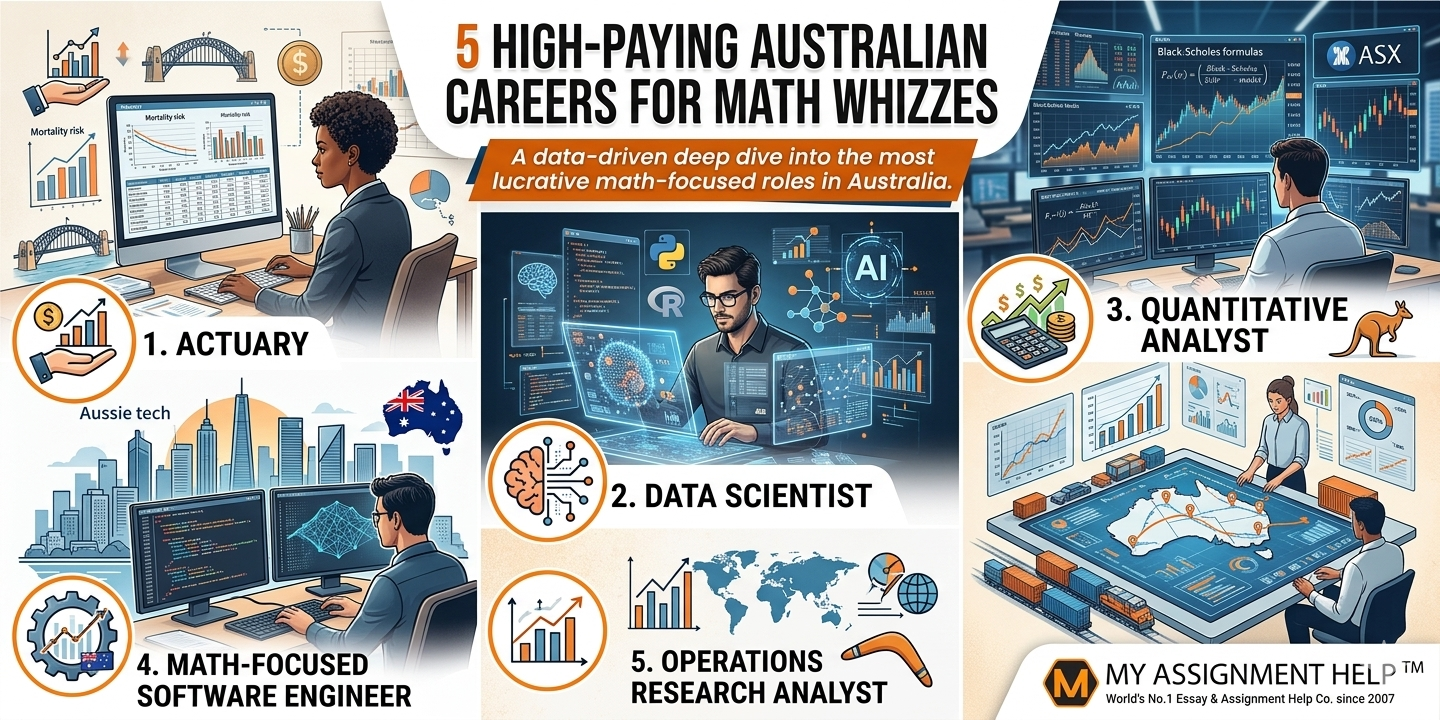
Australia’s economy is undergoing a massive digital and data-driven transformation. While traditional roles remain steady, the 2026 job market is placing an unprecedented premium on “quantitative literacy.” For those who can navigate complex calculus, stochastic modeling, and advanced statistics, the financial rewards are significant.
However, the path to a six-figure salary in mathematics isn’t just about knowing the formulas; it’s about applying them to solve real-world Australian challenges, from securing our digital borders to optimizing the energy grid. If you are currently navigating a rigorous degree, seeking Math Assignment Help can be a strategic move to ensure your academic foundations are strong enough to support these high-stakes careers.
Below, we explore five of the most lucrative careers in Australia that require heavy-duty math, backed by industry data and clear pathways for entry.
1. Quant Analyst (Quantitative Analyst)
Quant analysts are the “engineers” of the financial world. In Sydney and Melbourne’s bustling financial districts, quants use mathematical models to price securities, manage risk, and predict market trends.
- The Math: Differential equations, linear algebra, and probability theory.
- Average Salary: $130,000 – $220,000+ AUD.
- The Pathway: A Master’s or PhD in Mathematics, Physics, or Financial Engineering is standard. Major Australian banks like ANZ and Macquarie Group look for candidates who can bridge the gap between abstract math and algorithmic trading.
2. Actuary
Consistently ranked as one of the best jobs for work-life balance and pay, actuaries are the masters of risk. They use math and statistics to predict the likelihood of future events (like accidents or natural disasters) and help insurance companies remain solvent.
- The Math: Statistics, probability, and financial mathematics.
- Average Salary: $100,000 (Junior) – $250,000+ (Fellow).
- The Pathway: You must complete a degree accredited by the Actuaries Institute of Australia. Success in this field requires passing a series of rigorous professional exams while working in the industry.
3. Cryptographer/Cybersecurity Mathematician
With the Australian government’s increased focus on national security and the “REDSPICE” initiative, mathematicians are needed to develop and break encryption codes. This is “pure math” at its most impactful.
- The Math: Number theory, abstract algebra, and discrete mathematics.
- Average Salary: $120,000 – $180,000 AUD.
- The Pathway: A degree in Computer Science or Mathematics with a heavy focus on algorithm design. Security clearances are often required for government-adjacent roles within the Australian Signals Directorate (ASD).
4. Data Scientist (Algorithmic Specialist)
While “Data Science” is a broad term, the high-paying tier involves building the machine learning models that power everything from mining automation in Western Australia to retail logistics at Coles and Woolworths.
- The Math: Multivariable calculus, optimization, and Bayesian statistics.
- Average Salary: $115,000 – $175,000 AUD.
- The Pathway: Proficiency in Python or R is essential, but the competitive edge comes from understanding the mathematical logic behind the algorithms. Many professionals utilize assignment writing help during their postgraduate studies to master the complex documentation required for technical portfolios.
5. Renewable Energy Modeller
As Australia pushes toward “Net Zero,” the energy sector needs mathematicians to model grid stability and the intermittent nature of solar and wind power.
- The Math: Linear programming, numerical analysis, and fluid dynamics.
- Average Salary: $110,000 – $160,000 AUD.
- The Pathway: A background in Applied Mathematics or Engineering. Specialized roles are emerging in Brisbane and Adelaide as renewable hubs expand.
Key Takeaways
- High Barrier to Entry: These roles require more than just “knowing” math; they require the ability to model uncertainty and complex systems.
- Industry Demand: The Australian Bureau of Statistics (ABS) continues to project growth in “Professional, Scientific, and Technical Services” through 2030.
- Location Matters: Sydney and Melbourne dominate Finance, while Perth and Brisbane offer unique opportunities in Resource and Energy modeling.
- Continuous Learning: Most of these fields require ongoing professional certification or postgraduate research.
How to Get There: A Step-by-Step Guide
- Strengthen the Foundation: Focus on STEM subjects during your undergraduate years. Don’t shy away from “Pure Math” units—they provide the logic used in high-level cryptography and finance.
- Master Technical Tools: Learn MATLAB, Python, and SQL. Math in the professional world is executed via code.
- Seek Professional Mentorship: Join associations like the Australian Mathematical Society (AustMS) to network with industry leaders.
- Academic Excellence: Maintaining a high GPA is critical for entry-level “Grad Programs” at firms like Canva, Atlassian, or the Big Four banks.
FAQ (Frequently Asked Questions)
Q: Do I need a PhD to get these high-paying roles?
A: Not necessarily. While it helps for Quant and Research roles, an Honours degree or a Master’s combined with practical internship experience is often sufficient for Actuarial and Data Science positions.
Q: Are these jobs safe from AI?
A: Yes. While AI can calculate, it cannot yet “contextualize” risk or innovate new mathematical proofs for specific Australian regulatory environments. These roles involve high-level decision-making that AI supplements rather than replaces.
Q: What is the most “in-demand” math skill in Australia right now?
A: Statistical modeling and optimization are currently the most sought-after skills due to the growth of the tech and renewable energy sectors.
Author Bio
Dr. Helena Miller Senior Academic Consultant at MyAssignmentHelp Dr. Miller holds a PhD in Applied Mathematics from the University of Melbourne and has over a decade of experience in curriculum design and technical writing. She currently mentors students in navigating the rigours of STEM education, helping them translate academic theory into professional success in the Australian workforce.
Sources & References:
- Australian Bureau of Statistics (ABS) – Labour Force, Australia (2025/26 Projections).
- Actuaries Institute of Australia – Salary Survey and Market Report.
- Australian Government Department of Education – Quality Indicators for Learning and Teaching (QILT).
- Cyber Security Industry Advisory Committee – Annual Trends Report.
